
South African Yacht Crew Tax: When Working Overseas Stops Being the Simple Part

For South African yacht crew, working overseas can create an extraordinary opportunity to build wealth, but offshore earnings, changing tax residency, property ownership and years spent outside the country eventually have to form one coherent financial story.
There comes a point in many yacht careers when earning the money is no longer the complicated part. The salary is arriving, living costs aboard are largely covered and the years at sea have started turning into something more permanent: savings, investments, property or perhaps a life that is now genuinely based outside South Africa. For Jamie Hadley-Grave CA(SA), founder of Hadley-Grave Accounting & Tax, that is when yacht crew need to move beyond the familiar question of whether an exemption applies and start looking at the much bigger issue of where they are tax resident, what they can prove and how the financial decisions they make overseas will eventually be viewed back home.
South African Yacht Crew Tax Is Bigger Than a Day Count
Yacht crew naturally focus on days because the various foreign employment and seafarer provisions place considerable importance on time spent outside South Africa, but Hadley-Grave believes residency itself is too often reduced to that one measurement.
Working abroad does not automatically mean somebody has stopped being a South African tax resident, particularly in an industry where crew can spend most of the year aboard foreign vessels without ever establishing a permanent home somewhere else.
For SARS, the wider picture can matter. Where does somebody return between contracts? Where is their family? Where is their permanent home? Where have they established the ordinary social and financial ties that suggest one country, rather than another, is genuinely the centre of their life?
That can become complicated very quickly for yacht crew whose workplace may move between the Mediterranean, Caribbean and United States while South Africa remains the place they continue to regard as home.
Our earlier Yachting News editorial, South African Yacht Crew Tax: What Crew Must Prove to SARS, looked more closely at the exemptions themselves and the evidence required to support them. Hadley-Grave’s broader argument is that those exemptions still sit inside the taxpayer’s overall residency position, which becomes increasingly important as a career overseas turns into a long-term life.
Offshore Income Does Not Become Invisible
Offshore banking is entirely normal in yachting. Crew may be employed through one jurisdiction, work aboard a yacht registered in another, receive their salary in dollars or euros and hold those earnings in an account outside South Africa.
What Hadley-Grave pushes back against is the assumption that the location of the bank account somehow settles the tax question.
If somebody remains a South African tax resident, putting foreign employment income into an offshore account does not by itself remove the need to understand whether that income must be declared and whether a legitimate exemption applies.
The distinction matters even more in an era where international financial information is increasingly shared and compared across jurisdictions. Building a long-term financial plan around the belief that an offshore account will simply remain unseen is very different from understanding the rules that apply and being able to demonstrate why the income has been treated correctly.
That is where documentation becomes important. Passport and travel records, employment contracts, payslips, boarding passes, seaman’s books and other supporting evidence can become invaluable when somebody has to establish where they were, what they were doing and why a particular exemption was claimed.
Hadley-Grave’s approach is practical: keep the records while they are easy to obtain, because reconstructing six or seven years of international employment after the fact is considerably more difficult.
Ceasing Tax Residency Can Solve One Problem and Create Another
For some yacht crew, South Africa eventually stops being home in any meaningful sense. They establish permanent lives elsewhere, form relationships, build businesses or investments and reach the point where ceasing South African tax residency becomes a genuine consideration.
Hadley-Grave distinguishes that clearly from simply spending long periods overseas. A mobile working life is not necessarily the same thing as having permanently relocated, and SARS may look at the wider circumstances surrounding somebody’s life rather than accepting a foreign address as the entire story.
There can also be a financial consequence to leaving.
When South African tax residency ceases, certain assets may be treated as though they have been disposed of at market value, potentially creating a capital gains tax liability even though the asset itself has not been sold and the gain has not been realised in cash.
That can be particularly significant for yacht crew who have done exactly what the industry encourages them to do and used their high-earning years to build investment portfolios.
Someone entering yachting at 19 with few assets faces a very different decision from somebody considering the same residency change ten years later after accumulating investments and other wealth, which is why Hadley-Grave believes these conversations are better had before the financial structure becomes complicated rather than afterwards.
The Tax Problem You Ignore Eventually Meets the Life You Are Building
Hadley-Grave also works with crew who left South Africa, began earning internationally and simply never dealt with their tax position at all.
Sometimes that begins with a misunderstanding. Sometimes one missed year becomes three, then six, and eventually the problem feels large enough that doing nothing seems easier than confronting it.
His message to crew in that position is not that the situation is beyond repair. Records can be reconstructed, historic obligations can be addressed and a route back towards compliance can usually be explored, but unresolved tax history has a habit of resurfacing when somebody is trying to do something else.
Buying property is a good example.
A yachtie may have spent years earning strong money and built a substantial deposit, yet suddenly discover that obtaining financing or demonstrating a coherent financial history becomes considerably more complicated when years of tax administration were never dealt with.
At that point, the issue is no longer an abstract argument about SARS. It is interfering with the very reason many people joined yachting in the first place: to create options, assets and financial security.
Leaving South Africa Does Not Mean Leaving Your Investments Behind
Becoming a non-resident does not require somebody to remove every financial connection with South Africa, and property is an area where Hadley-Grave believes this distinction matters.
A non-resident can still own South African property and earn rental income, although South African-source income may remain taxable in South Africa even when the owner is no longer resident there for tax purposes.
For yacht crew building property portfolios, the calculation can also look different from simple cash flow.
A monthly bond payment may exceed the rent received, giving the impression that a property is making a loss, while the tax calculation may treat the interest component differently from the repayment of capital. Maintenance, levies, agency fees and other qualifying expenses may also affect the eventual taxable result.
The wider point is that turning yacht income into property or investments creates a different set of financial questions from simply earning the salary in the first place.
The Opportunity Is Too Good to Waste
Hadley-Grave remains remarkably positive about the financial position yacht crew can create. Strong foreign earnings combined with accommodation, food and many ordinary living costs being covered aboard can give disciplined crew a financial advantage that would be difficult to reproduce in most land-based careers.
What he challenges is the idea that working at sea somehow places those earnings outside the normal financial system.
Using legitimate exemptions is not the same thing as hiding income, and structuring a tax position efficiently is not the same thing as ignoring it. The real advantage comes from understanding the rules early enough to use them properly, keeping the evidence required to support that position and making decisions about residency, investment and property before those decisions become significantly more expensive to unwind.
For an industry already built around certification, documentation and proving that procedures have been followed, that principle should feel familiar.
The yacht may move, the income may be earned halfway around the world and the bank account may sit offshore, but sooner or later the financial story still has to make sense on paper.
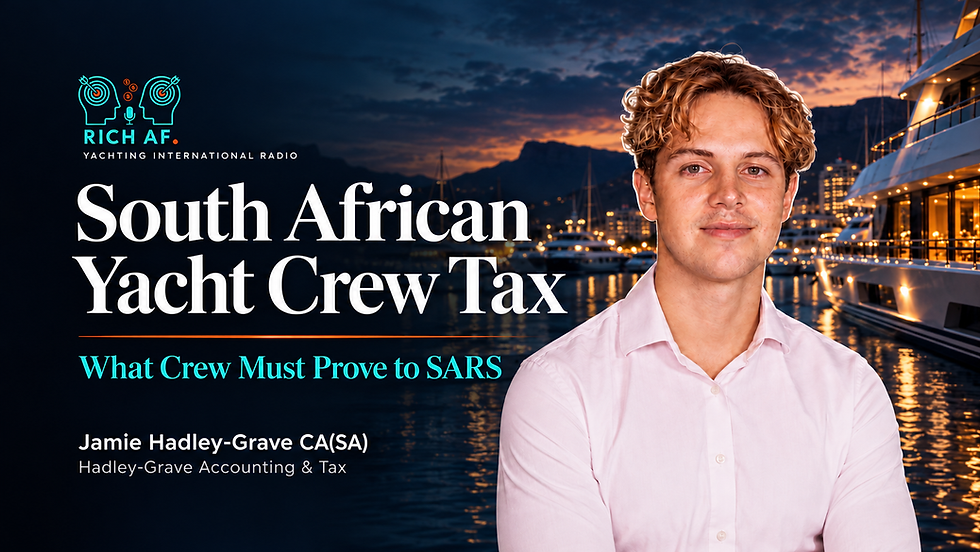
Jamie Hadley-Grave CA(SA) is founder of Hadley-Grave Accounting & Tax and works with South Africans earning internationally, including yacht crew navigating foreign employment income, tax compliance and residency issues.
This editorial reflects the views and professional experience shared by Jamie Hadley-Grave and is provided for general information only. It does not constitute tax, accounting, financial, investment or legal advice. Individual circumstances and applicable tax rules vary, and professional advice should be obtained before making decisions regarding tax residency, exemptions or filing obligations.


Comments