
Embodiment in High-Pressure Environments: Why Walking Your Talk Matters More Than Ever

There is a fundamental difference between understanding something intellectually and living it in practice, and nowhere does that distinction become more visible than in environments where pressure is constant, expectations are high, and the ability to pause is often limited.
Across yachting, business, and leadership, the language of self-care, resilience, and wellbeing has become increasingly present, woven into conversations, training, and culture. Yet the consistent application of those principles remains far less certain, particularly when individuals are required to perform under sustained pressure while navigating uncertainty, external expectations, and continuous demand.
It is within this gap that embodiment becomes not only relevant, but necessary.
Because understanding a concept does not change behaviour. Living it does.
Embodiment in Practice: The Point Where Theory Meets Reality
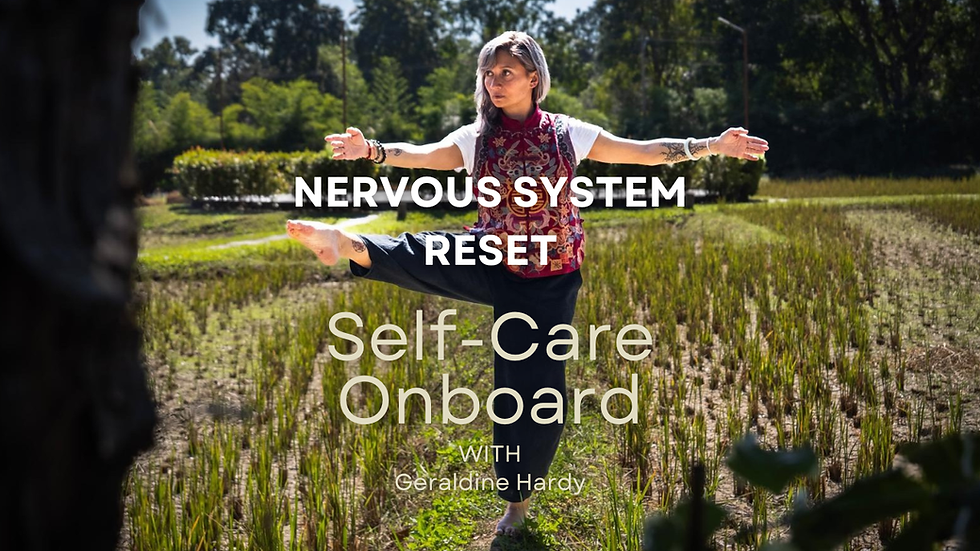
Embodiment, as explored by Geraldine Hardy, is not positioned as a philosophy to be adopted in moments of calm, but as a lived standard that reveals itself when conditions are less predictable.
“Embodiment is not defined by what is said in moments of clarity, but by how an individual responds when clarity is replaced by pressure, doubt, or uncertainty.”
This distinction moves the conversation away from intention and toward behaviour, placing emphasis on how individuals operate over time rather than how they present in controlled environments.
Because it is easy to speak about self-awareness, discipline, and emotional regulation when outcomes are predictable and the path forward is clear. It becomes far more revealing when those same principles are tested in moments where direction is uncertain and external influence is at its strongest.
In those moments, what remains is not what has been learned, but what has been integrated.
Operating Within Constant Influence
Within high-performance environments, and particularly within yachting, the conditions themselves introduce a constant stream of external input. Expectations from clients, direction from leadership, influence from peers, and the broader culture of the industry combine to create an environment where perception can shift quickly and where maintaining clarity requires conscious effort.
Geraldine’s perspective does not suggest removing these influences, because that would be unrealistic. Instead, it centres on developing the ability to discern which of them hold relevance and which do not.
“Not every opinion carries weight, and not every perspective is aligned with your direction.”
This becomes increasingly important for those who are building businesses, transitioning out of established roles, or stepping into leadership positions where the volume of external feedback increases and the margin for hesitation narrows.
Without a grounded sense of self-trust, that feedback can begin to shape decisions in ways that are not immediately visible, but become evident over time through subtle shifts in focus, energy, and direction.
Where Misalignment Quietly Takes Hold
Misalignment rarely presents itself as a single, defining moment. More often, it develops gradually, through a series of small decisions that begin to reflect external pressure rather than internal clarity.
It may begin with a minor compromise, a decision made to accommodate expectation rather than conviction. Over time, those decisions accumulate, creating a pattern that becomes increasingly difficult to recognise from within.
Energy becomes divided across competing priorities. Focus shifts away from long-term intent toward short-term validation. Confidence, once rooted in direction, begins to rely on reassurance.
What follows is not immediate failure, but gradual erosion.
And in environments where performance is expected to remain consistent, that erosion is often masked until it reaches a point where it can no longer be ignored.
Respecting Individual Paths Without Defaulting to Judgment
A central element of Geraldine’s work is the recognition that embodiment is inherently individual, shaped by personal experience, perspective, and lived reality rather than a fixed or universal framework.
“No one else is positioned to define your path, and it is not your place to define theirs.”
This introduces a level of responsibility that extends beyond the individual and into how others are perceived and assessed.
In environments where comparison is constant and performance is visible, it is easy to default to judgment, to interpret another person’s decisions through a personal lens of what is considered right or wrong.
Yet doing so overlooks the reality that each individual is operating within their own set of experiences, beliefs, and circumstances, none of which are fully visible from the outside.
To recognise this is not to remove accountability, but to introduce awareness, to understand that perspective is not the same as truth, and that what appears obvious from one position may be entirely different from another.
Holding Direction When It Becomes Difficult
What emerges most clearly through Geraldine’s perspective is not the absence of external influence, but the inevitability of it, particularly in environments where expectation, performance, and perception are in constant interplay. The challenge, therefore, is not to remove those influences, which would be neither realistic nor desirable, but to develop the capacity to remain anchored within them, to recognise where input holds value and where it begins to dilute direction.
In this context, clarity is not a fixed state that can be relied upon once established. It requires maintenance. It is shaped, challenged, and, at times, quietly eroded by the accumulation of opinions, expectations, and well-intentioned advice that, while valid within their own frame of reference, do not necessarily align with the path an individual is navigating.
What makes this particularly complex is that the shift away from alignment rarely presents itself in a way that is immediately recognisable. It does not arrive as a decisive break, but rather as a gradual redirection, a series of subtle adjustments made in response to external pressure, each of which appears reasonable in isolation, yet collectively begins to alter the course.
Geraldine’s work brings attention to this process not as something to be resisted outright, but as something to be understood with greater precision. The question is not whether external voices will be present, but whether they are being integrated with discernment, or allowed to influence without examination.
The Discipline Behind Self-Trust
There is a tendency to frame self-trust as something instinctive, a quality that either exists or does not, yet in practice it reveals itself as something far more deliberate, constructed over time through repeated alignment between intention and action.
It is not strengthened in moments where the path is clear and the outcome is predictable, but in those instances where uncertainty becomes more pronounced and the absence of immediate validation requires a different kind of commitment. In these moments, self-trust is less about confidence and more about continuity, about the willingness to move forward without the reassurance that often accompanies more stable conditions.
Geraldine does not position this as a linear process, nor as one that unfolds without interruption. There are moments where direction is questioned, where the weight of external perspective becomes more difficult to filter, and where the easier course would be to adjust in order to reduce friction.
What defines the process is not the absence of those moments, but the ability to recognise them without allowing them to determine the outcome. The return to alignment, even when it requires recalibration, becomes the point at which self-trust is reinforced rather than diminished.
The Standard That Remains When Everything Else Moves
Within this framework, embodiment is not presented as an outcome to be achieved, but as an ongoing standard that is continually shaped by experience, awareness, and the ability to remain accountable to one’s own direction over time.
It does not eliminate challenge, nor does it remove the presence of uncertainty, both of which remain inherent to any environment where growth, transition, and performance intersect. What it provides is a point of internal reference that does not fluctuate in response to external conditions, allowing decisions to be made from a place of clarity rather than reaction.
Over time, this becomes evident not through what is stated, but through what is sustained, in the consistency of action, in the steadiness of direction, and in the ability to remain aligned when circumstances would make it easier not to be.
And it is within that consistency that embodiment moves beyond concept, becoming something that is not only experienced internally, but recognised externally, often without the need for articulation.


Comments